PEDIATRIC SAFETY AND RISK MANAGEMENT
FREE
No payment required
PEDIATRIC SAFETY AND RISK MANAGEMENT
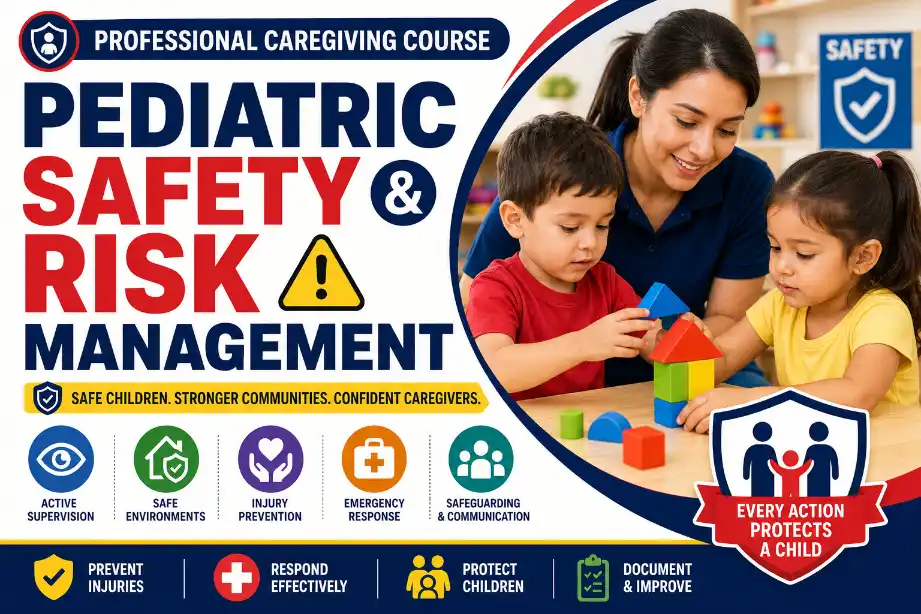
Master practical pediatric safety and risk management skills for caregiving environments. This course teaches learners how to prevent common injuries, supervise children actively, recognize hazards, respond to emergencies, protect children from harm, communicate with families, document incidents objectively, and support safe routines with dignity and professionalism
Pediatric safety is one of the most important responsibilities in caregiving. Children learn by exploring, moving, touching, climbing, tasting, imitating, and testing limits. These normal developmental behaviors can create risk when environments are poorly arranged, supervision is passive, routines are unclear, or adults miss early warning signs. This course gives learners a practical foundation in pediatric safety and risk management. It covers active supervision, developmental risk, hazard recognition, injury prevention, infection control, food and medication safety, emergency preparedness, behavioral risk, safeguarding, documentation, family partnership, and continuous improvement. Lessons are written in plain language and connected to real caregiving situations. Learners will practice thinking like safety-minded caregivers: anticipate predictable risks, position themselves effectively, complete name-to-face checks, support children through transitions, follow health and emergency procedures, communicate respectfully with families, document objectively, and escalate concerns within role. The course emphasizes child dignity, cultural respect, family partnership, and caregiver boundaries. Key Points • Caregivers are not expected to diagnose injuries, illnesses, abuse, or medical conditions. • Caregivers are expected to observe carefully, act within role, report promptly, and follow approved procedures. • Examples should be localized for legal requirements, licensing standards, child protection systems, and emergency contacts.
What You Will Learn In This Course
Course Modules
7 modulesModule 3
MODULE 4: HEALTH, HYGIENE, AND INFECTION RISK MANAGEMENT
Who Is This Course For?
-
This course is appropriate for new and experienced caregivers, childcare assistants, pediatric support workers, home visitors, family caregivers, community health workers, babysitters, early childhood support staff, and students preparing for child-focused roles. It is also useful for agencies and instructors who need structured safety training content.
-
Learners should move through the modules in order because later lessons build on earlier safety concepts. Instructors may add demonstrations, local policies, emergency forms, first aid practice, scenario discussions, short quizzes, role-play, and workplace observations. Because pediatric safety requirements vary by location, all learners should follow local laws, licensing standards, child protection procedures, and organizational policy.
-
Key Points
-
Use reflection questions for journals, discussions, or assignments.
-
Use mini activities as short practice tasks or scenario exercises.
-
Add local emergency numbers, poison control contacts, child protection contacts, and licensing rules before publishing.
-
Review all clinical, legal, and emergency content with qualified local experts.