AGE-APPROPRIATE COGNITIVE STIMULATION
FREE
No payment required
AGE-APPROPRIATE COGNITIVE STIMULATION
Master practical, age-appropriate cognitive stimulation strategies for caregiving settings. This course teaches learners how to choose safe, meaningful activities that support attention, memory, language, curiosity, problem-solving, social connection, and confidence while respecting each person's age, culture, ability, preferences, and care plan
Cognitive stimulation is not limited to worksheets, puzzles, or formal teaching. It happens when a caregiver talks with an infant, reads with a toddler, offers a preschooler choices, helps a school-age child plan a task, supports an adolescent's self-expression, or invites an older adult to share memories and routines. Meaningful stimulation helps people stay engaged, practice skills, build confidence, and participate more fully in daily life. This course explains how caregivers can provide stimulation that is safe, respectful, and matched to developmental stage and individual ability. Learners explore brain development, play, language, sensory learning, social interaction, routines, executive function, memory support, inclusive activity planning, environmental design, documentation, family partnership, ethics, and professional boundaries. Key Points
• The course does not train learners to diagnose developmental delay, prescribe therapy, interpret clinical assessments, or replace licensed professionals.
• The course prepares caregivers to observe, support, adapt, report, document, and encourage meaningful cognitive engagement safely.
• Instructors should adapt examples, activity lists, emergency procedures, and local referral information according to country, organization, and learner setting.
What You Will Learn In This Course
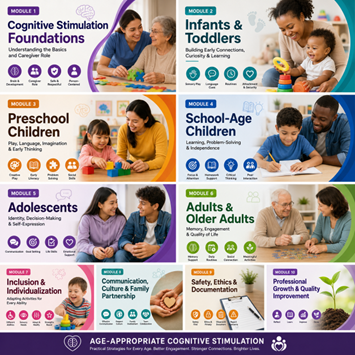
Course Modules
11 modulesModule 3
MODULE 3: PRESCHOOL AND EARLY CHILDHOOD
Course Requirements
- Use reflection questions for assignments, journal prompts, or discussion boards.
- Practice activity planning with safety and supervision in mind.
- Adapt examples to local laws, cultural expectations, and organizational policy.
- Remember that cognitive stimulation should never replace clinical evaluation when developmental, neurological, mental health, or safeguarding concerns arise.