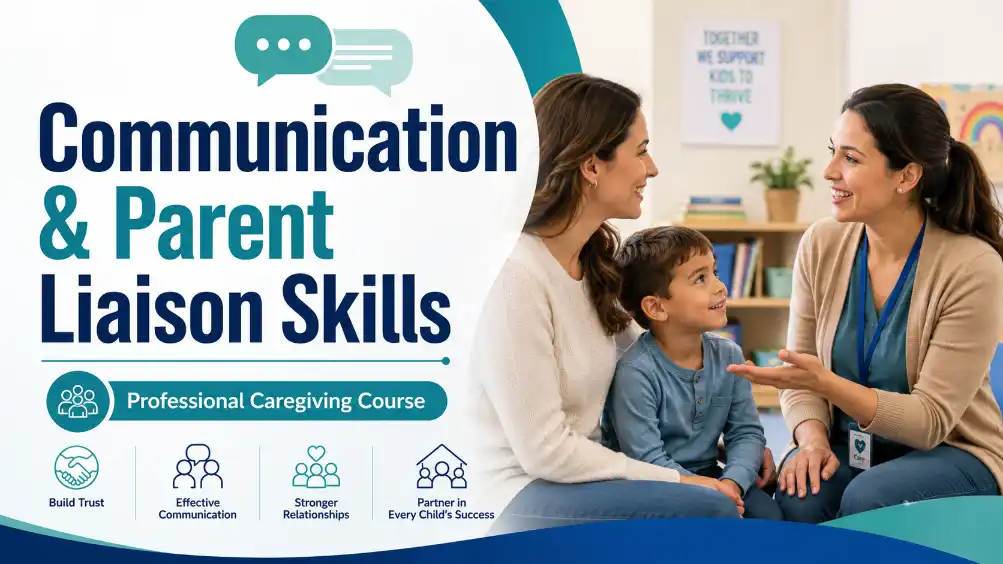
Communication and Parent Liaison Skills
$40.00
Communication and Parent Liaison Skills
Build professional communication and parent liaison skills for caregiving and childcare settings. This course teaches learners how to communicate respectfully with parents and guardians, share observations clearly, document objectively, protect confidentiality, handle difficult conversations, support family partnership, and stay within professional boundaries
Communication is one of the most important professional skills in caregiving. A caregiver may complete many practical tasks each day, but the quality of care often depends on how well information is shared, how respectfully families are treated, and how accurately concerns are reported. Parent liaison work is not simply passing messages. It is building trust, protecting privacy, and helping adults work together around a child's needs. This course teaches communication and parent liaison skills for professional caregiving environments. Learners explore active listening, strengths-based language, family-centered communication, daily updates, incident communication, behavior discussions, documentation, confidentiality, conflict management, cultural responsiveness, safeguarding boundaries, and teamwork with supervisors and other professionals. Every module is written in plain language and connected to real caregiving practice. Learners will see how to communicate during drop-off and pick-up, how to write objective notes, how to respond when a parent is upset, how to ask respectful questions, how to involve supervisors, and how to avoid giving advice beyond their role. Key Points • This course does not train learners to diagnose children, provide therapy, make legal decisions, or replace supervisors, educators, social workers, nurses, or licensed professionals. • The course prepares caregivers to observe, listen, document, report, communicate respectfully, and support family partnership within role. • Instructors should adapt examples, reporting processes, privacy rules, and safeguarding procedures to local law and organizational policy.
What You Will Learn In This Course
Course Modules
10 modulesModule 3
MODULE 3: DAILY COMMUNICATION SYSTEMS
Who Is This Course For?
-
This course is appropriate for new and experienced caregivers, childcare assistants, early years educators, classroom assistants, home-based child caregivers, family support workers, community program staff, and caregiving students. It is also useful for organizations that need structured training content on parent communication and family liaison practice.
-
Learners should move through the modules in order because later lessons build on earlier communication foundations. Instructors may add role plays, discussion boards, workplace policies, sample forms, local safeguarding procedures, communication scripts, and reflective assignments. Because legal requirements and organizational processes vary, all learners should follow local policy and supervisor guidance.
-
Key Points
-
Read each lesson actively and connect it to real caregiving conversations.
-
Practice scripts aloud to build confidence and calm tone.
-
Use reflection questions for assignments or discussion boards.
-
Adapt examples to local family structures, languages, cultural norms, and legal requirements.
-
Review workplace confidentiality and safeguarding procedures before publishing or teaching the course.