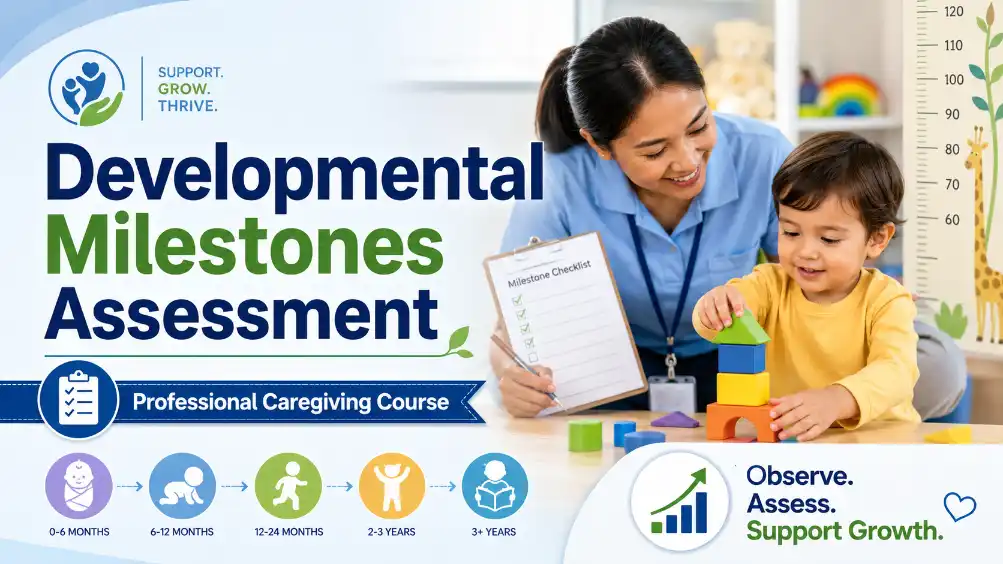
DEVELOPMENTAL MILESTONES ASSESSMENT
FREE
No payment required
DEVELOPMENTAL MILESTONES ASSESSMENT
Build caregiver-focused skill in observing and supporting child development through practical milestone awareness. This course teaches learners how to understand developmental domains, observe children in daily routines, document objective examples, recognize concerns, communicate respectfully with families, and follow appropriate referral pathways without diagnosing or overstepping scope.
Developmental milestone assessment is an important part of child-focused caregiving. Children communicate their growth through movement, play, language, relationships, self-help routines, emotional regulation, and curiosity. Caregivers who know what to look for can support development, notice concerns early, and communicate useful information to families and professionals. This course is written in plain language and focuses on practical caregiver responsibilities. Learners explore developmental domains, age-related milestones, observation methods, documentation, family partnership, cultural responsiveness, inclusion, early support, safeguarding, ethics, and professional development. Each lesson includes caregiver practice points, an applied example, a reflection question, and a mini activity. The course does not train learners to diagnose developmental delays, assign clinical labels, score standardized tests without authorization, or replace pediatricians, psychologists, therapists, early intervention providers, or licensed professionals. It prepares caregivers to observe, support, document, report, and communicate within role. Key Points • Milestones are guideposts for observation, not rigid judgments. • Caregivers should document facts, strengths, concerns, context, and support responses. • Families bring essential knowledge about language, culture, home routines, and history. • When concerns persist, early communication and referral can reduce delays in support.
What You Will Learn In This Course
Course Modules
10 modulesModule 3
MODULE 3: TODDLER MILESTONES FROM 12 TO 36 MONTHS
Who Is This Course For?
-
This course is appropriate for new and experienced caregivers, childcare staff, family caregivers, healthcare assistants, early childhood support workers, community health workers, home visitors, parent educators, and students preparing for roles that involve children. It is also useful for organizations that need structured training material for developmental observation and support.
-
Learners should move through the modules in order because later lessons build on earlier concepts. Instructors may add local referral pathways, country-specific policies, approved screening tools, role-play activities, observation assignments, discussion boards, and quizzes. Because laws, professional roles, and referral systems vary by location, the course should be adapted to local requirements before publication.
-
Key Points
-
Use reflection questions for journals or discussion boards.
-
Use mini activities for assignments or short practice tasks.
-
Adapt examples to local childcare, healthcare, and early intervention systems.
-
Update resources before publishing on Udemy.
-
Do not present the course as diagnostic or clinical testing training.