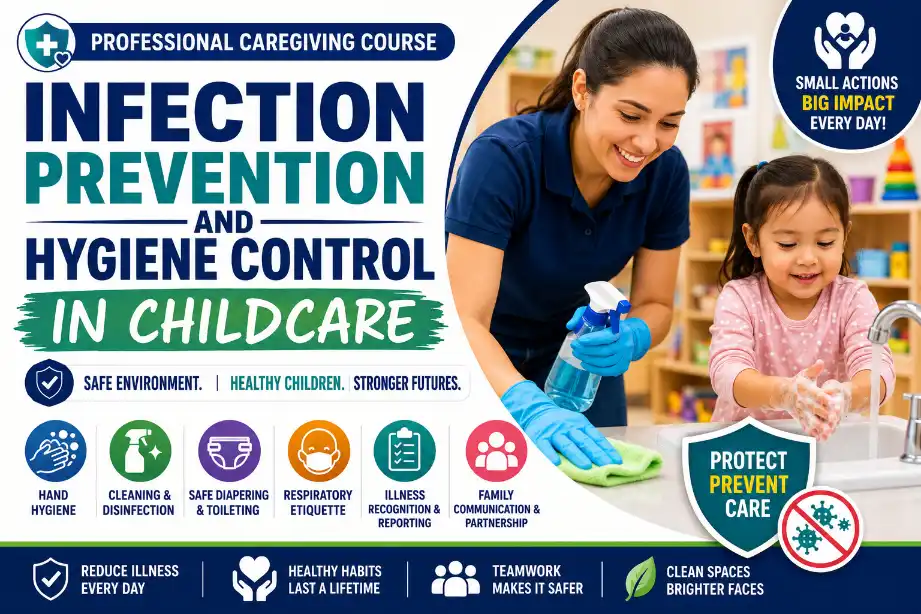
INFECTION PREVENTION AND HYGIENE CONTROL IN CHILDCARE
FREE
No payment required
INFECTION PREVENTION AND HYGIENE CONTROL IN CHILDCARE
Master practical infection prevention and hygiene control skills for safer childcare environments. This course teaches caregivers how to reduce the spread of illness through hand hygiene, cleaning routines, diapering and toileting practices, food safety, respiratory etiquette, illness reporting, family communication, and respectful documentation.
Infection prevention is one of the most important responsibilities in childcare. Young children naturally explore with their hands and mouths, need help with toileting and hygiene, share toys and learning spaces, and depend on adults to create safe routines. Because of this, childcare caregivers play a vital role in reducing the spread of respiratory illness, gastrointestinal illness, skin infections, foodborne illness, and other preventable health risks. This course provides practical, caregiver-focused training on hygiene control in childcare. Learners explore how germs spread, when and how to support hand hygiene, how to keep diapering and toileting routines safe, how to clean toys and surfaces, how to respond to symptoms, how to communicate with families, and how to document concerns objectively. The course emphasizes prevention, dignity, inclusion, teamwork, and staying within caregiver scope of practice. The course does not train learners to diagnose illness, prescribe treatment, interpret laboratory results, or replace licensed healthcare professionals. It prepares caregivers to observe, prevent, support, report, clean, document, and communicate safely according to local policy and professional guidance. Key Points • The course is written in plain language for childcare and caregiving learners. • The course focuses on daily routines rather than advanced clinical infection control. • Instructors should adapt policies, exclusion rules, and emergency contacts to local regulations. • Learners should always follow their workplace policy, supervisor instructions, and qualified health guidance.
What You Will Learn In This Course
Course Modules
5 modulesModule 3
MODULE 3: DIAPERING, TOILETING, AND BODY FLUID SAFETY
Who Is This Course For?
-
This course is suitable for new and experienced childcare caregivers, early childhood assistants, home-based childminders, nannies, family caregivers, classroom aides, parent liaison staff, and students preparing for roles in childcare or family support. It is also useful for childcare programs that need structured hygiene training content for staff onboarding or professional development.
-
Learners should move through the course in order because later modules build on earlier foundations. Instructors may add local policies, licensing rules, exclusion charts, cleaning-product instructions, emergency contact procedures, quizzes, case discussions, role-play activities, and practical demonstrations. Because health guidance and childcare regulations vary by location, all examples should be adapted to the learner's country, organization, and role.
-
Key Points
-
Use reflection questions for journal prompts or discussion boards.
-
Use mini activities for assignments, demonstrations, or workplace practice.
-
Update local illness policies and emergency procedures before publishing.
-
Teach learners to follow policy and escalate concerns instead of guessing.
-
Keep the course focused on caregiving support rather than medical diagnosis.